
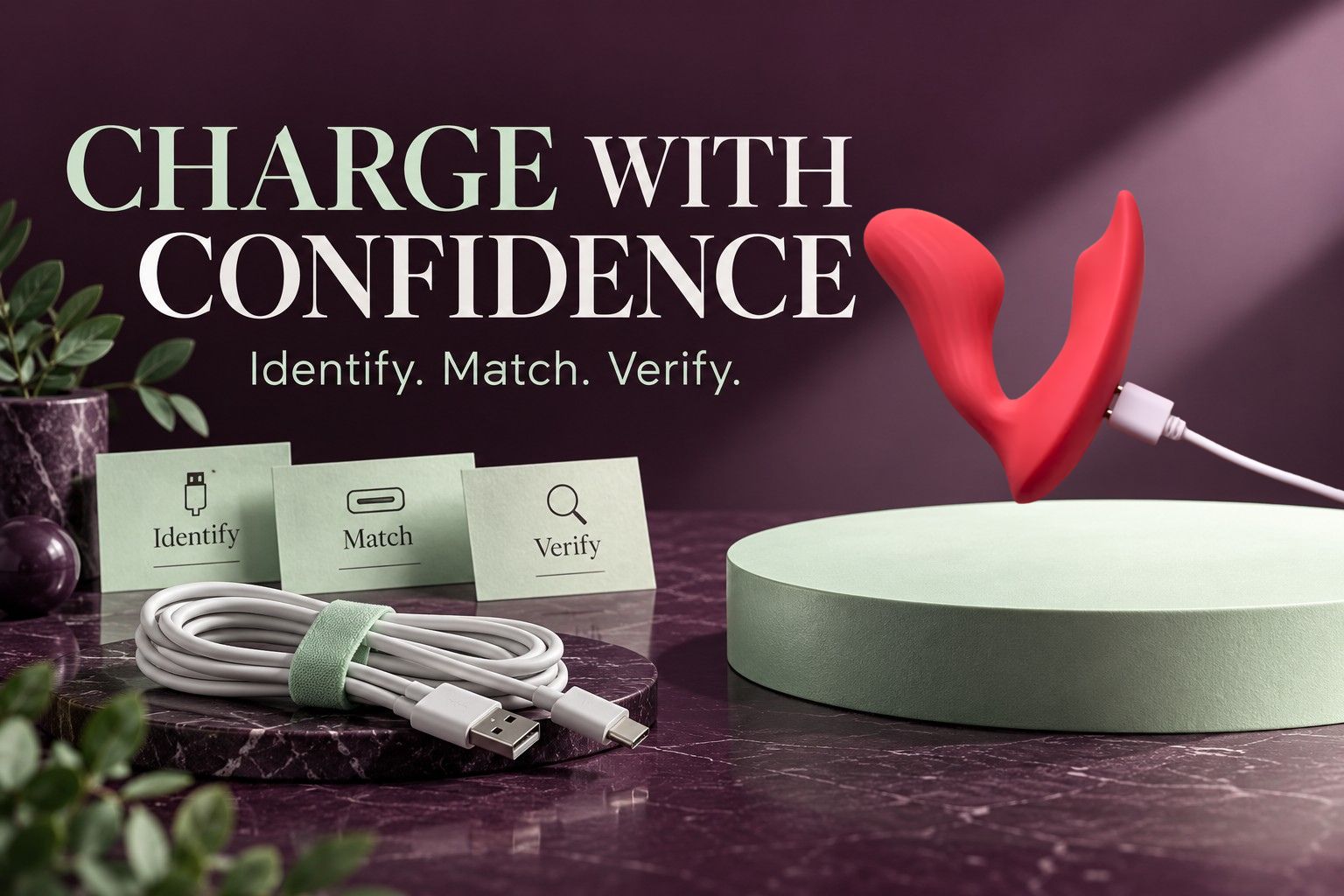
A vibrator charger is only a useful replacement when it matches the exact device. A connector that looks right, clicks into place, or fits a socket does not establish electrical compatibility. Start with the brand, model, original instructions, and approved replacement part. Then check the power source and the condition of the device. If those details are missing, ask the seller to identify the correct cable before connecting an unknown one.
Losing a small charging lead can feel disproportionately frustrating. The device may still be in good condition, yet a drawer full of similar cables offers no clear answer. This guide gives adult owners a practical way to sort that uncertainty. It explains what to record, what a product description should tell you, and how to describe a charging problem without exposing unnecessary personal information. It is an equipment care guide, not a substitute for the instructions supplied with a particular model.
The short answer: match the model before the magnet
Identify the exact device, find its official charging instructions, and use a replacement explicitly approved for that model. Confirm the specified power supply separately from the cable. Inspect the connector and enclosure, keep the charging area dry, and follow the stated charging procedure. Stop if the device is damaged or behaves abnormally. Do not improvise a connection simply because two magnetic contacts appear to line up.
That sequence matters because the most visible part of a charger is often the least informative. A magnetic head tells you how a lead attaches. It does not, on its own, tell you the required electrical arrangement, the accepted supply, or the charging behavior of the device. Treat an attractive listing photograph as an identification aid rather than a compatibility certificate. The useful buying question is not whether the connector resembles yours, but whether the seller can name your exact model as supported.
First separate the cable, adapter, and charging circuit
People often use the word charger for three different things. The cable connects the device to a power source. A wall adapter supplies power through its output port. Charging control may be built into the device itself. A fault or mismatch involving any one of these parts can prevent normal charging, so replacing the cable without identifying the problem can waste money and create more uncertainty.
Par exemple, a listing may show a USB lead but no wall adapter. Another may include an adapter with a particular output specification. A third may describe a mains powered device that is not rechargeable at all. Read the package contents and power instructions together. Never assume that a cable pictured beside a product is included, or that every device in the same category uses the same charging arrangement.
This distinction also helps when contacting support. Instead of saying that the charger is broken, describe the specific component: the cable jacket is split, the magnetic head no longer stays attached, the device shows no charging indicator, or the original wall adapter is missing. A precise observation gives support a better starting point than a conclusion about which internal component must have failed.
Identify the device without guessing from its shape
Start with the order confirmation, packaging, manual, and any model marking on the device. Record the brand and complete model name, including a version number if one is shown. Product families can contain several devices with similar shapes and different accessories. A color match is useful for organizing your own belongings but is not a reliable way to identify an electrical replacement part.
If the original listing is gone, keep the order number and the seller name together. Ask the seller whether the model has been renamed or revised. A current product with a similar name may not be the same version that you purchased. Do not erase that distinction when comparing instructions. If support cannot confirm which version you own, the uncertainty remains unresolved even when a marketplace title says that its cable is universal.
Take a clear photograph of the connector area if support needs one. Keep the device switched off and unplugged while photographing it. Crop out addresses, payment details, faces, and unrelated objects before sharing. A close view of the label and connector is normally more useful for identification than a picture of an entire room. Share only what the seller needs to match the product and accessory.
Why magnetic vibrator chargers are not automatically interchangeable
Magnetic attachment is a convenience feature, not a universal standard for every personal massager. Products may differ in contact layout, spacing, cable construction, and the electrical arrangement expected by the device. You cannot verify all of those properties by watching the magnets attract. A cable that stays attached may still be the wrong accessory for the model.
An instructive real example is the official Lovense USB charger page. It lists different replacement charger types alongside their supported devices. That is evidence for checking an explicit compatibility list rather than assuming that every product from one brand shares a lead. It does not establish compatibility between a Lovense cable and a product from another manufacturer, and it does not make an unlisted model safe to connect.
The same caution applies to advice about turning a magnetic connector around. Some model instructions describe a particular orientation check. Such an instruction belongs to the named model. Do not turn that into a general repair technique for unknown cables. If the approved instructions explain a reversible connection, follow them. If they do not, ask support instead of experimenting with multiple leads and orientations.
USB at one end does not answer every compatibility question
USB describes a connection system, but a familiar plug at the supply end does not identify the proprietary connector at the device end. Check both ends of the cable and the device instructions. A matching USB port on your adapter is not proof that the complete charging setup is suitable. The approved cable and required supply specification must be considered together.
Read the label on the adapter and compare it with the manufacturer instructions. Do not choose an adapter solely because its marketing calls it fast, puissant, or premium. Equally, do not infer that every adapter with a high maximum rating necessarily forces that output into every device. The practical decision remains the same: use a supply that the device manufacturer specifies as acceptable, with the approved connection method.
If the instructions are unclear about an adapter, ask a concrete question. State the device model and the output information printed on the adapter, then ask whether that combination is approved. You do not need to explain how you use the product. Keep the discussion focused on the electrical accessory. If the answer is vague, request the relevant manual page or an exact approved replacement reference.
Read a replacement listing as a checklist
Before ordering, look for the complete supported model list, a part identifier if available, clear photographs of both cable ends, and an explanation of what is included. A useful listing also states who supplies the accessory and how to get help if the model match is uncertain. An unexplained claim of universal compatibility is a reason to request clarification, not a reason to skip the checks.
Do not treat a list of visual measurements as a complete compatibility test. Measurements may help support distinguish between two accessories, but they cannot establish every electrical property. Similarly, a customer review saying that a cable worked for someone else is only relevant if the same device and version can be established. Even then, the manufacturer or authorized supplier remains the stronger source for the intended accessory.
Save the compatibility confirmation with the order record. This is useful if a parcel contains a different item, the model name changes, or you need another cable later. Record the exact item purchased rather than a generic search phrase. If no confirmed replacement is available, it is better to leave the device unused while asking about service options than to keep purchasing visually similar leads.
Set up a straightforward charging routine
Choose a dry, stable place where the cable will not be pulled or trapped. Keep the setup away from liquids and from surfaces that prevent you from noticing a problem. Check that the connector is clean and dry using the cleaning method approved by the manufacturer. Do not scrape contacts with metal tools, insert objects into a port, or add cleaning liquids that the instructions do not permit.
Follow the model instructions about switching the device off, connecting the lead, and interpreting the charging indicator. Different products can use different light patterns and completion signals. A dark indicator can mean different things depending on the device, so do not assume that it always means a full battery or always means a fault. Look up the meaning before making that conclusion.
Use the stated charging duration as guidance for that model, not as a universal rule for every vibrator. Keep the charging setup within the conditions described by the manufacturer. If you notice unusual heat, a changed shape, an unfamiliar smell, damaged wiring, or other abnormal behavior, stop using the device and seek the manufacturer guidance. Do not open a sealed battery enclosure to investigate it yourself.
When there is no charging light
Begin with identification, not repeated plugging and unplugging. Confirm that you have the original or explicitly approved cable. Check the manual to see whether a light is expected at this stage and whether the device must be switched off. An incorrect expectation about the indicator can look like a hardware failure, so establish the intended behavior before replacing anything.
Next inspect the visible condition of the cable, contacts, and enclosure while disconnected. If anything is damaged, do not continue a troubleshooting sequence that involves powering it. If everything appears intact, follow only the checks listed in the instructions, such as confirming the specified source or reconnecting the approved lead. Avoid improvised electrical tests or combinations of unknown adapters and cables.
Write down the result of each permitted check. Useful notes include the model, the approved cable identifier, the indicator behavior, when the issue began, and whether the device had recently been cleaned. Avoid stating that the battery is dead unless a qualified service assessment establishes that. The same visible symptom can have more than one explanation, and a short factual log helps support distinguish them.
When charging appears to work but runtime changes
Runtime can vary with the operating setting and the condition of the product, but a change does not automatically identify its cause. Compare the observed behavior with the model instructions and with your own prior experience under similar conditions. A marketing maximum may describe a particular test setting rather than the duration every owner will see in every use.
Record whether the device reached its stated full charge indicator, which setting was used, and roughly how long it operated. There is no need to run a device repeatedly until it stops just to produce a perfect number. Follow the manufacturer guidance on battery care. Do not attempt to reset or condition a battery using an internet routine intended for a different product or battery technology.
If the change is substantial or accompanied by abnormal behavior, ask about service or replacement. A sealed rechargeable product may not have a user replaceable battery. Opening it can damage the enclosure and compromise its intended protections. Treat an unavailable replacement cable or battery as a support question, not an invitation to splice wires, substitute cells, or bypass the charging system.
Cleaning and water resistance are separate from charging permission
A water resistance claim does not automatically permit charging in a wet environment. Read the care instructions for the whole system, including the device, charging contacts, detachable controller, and adapter. The presence of a sealed looking body tells you little about an exposed connection. Drying requirements and charging restrictions belong to the specific model instructions.
After cleaning, allow the product and its connection area to become fully dry as instructed before charging. Do not use heat or other drying methods unless the manufacturer permits them. Keep the adapter and cable away from water during this process. If liquid may have entered a damaged enclosure or an unprotected port, stop and ask for guidance instead of connecting power to see whether the product still works.
For a broader care routine, see our guide de nettoyage des sextoys. Use that general discussion alongside the individual manual. Where a general article and the product instructions differ, follow the instructions for the actual device. A category name such as waterproof vibrator is not a replacement for the operating and care limits of an individual product.
Keep the correct cable with the correct record
A small organization habit can prevent the next lost cable problem. Give the device and its approved lead the same neutral label, such as a letter or a private inventory number. Keep the model name and manual reference in a separate note. The label is an organizational aid for you; it does not change or replace the compatibility information supplied by the manufacturer.
Store clean, dry items according to their instructions and avoid bending a cable sharply at its connector. Keep accessories separated enough that you can identify them without untangling several similar magnetic heads. If you share a household, a discreet storage system can be simple: an opaque container, clear private labels, and a record that only you need to understand.
Notre storage ideas guide offers broader organization options. Do not seal away an item that still needs to dry, and do not assume that every pouch material is suitable for every product surface. The aim is to reduce mix ups while preserving the care conditions for the device, rather than collecting more accessories than you can confidently identify.
Travel preparation begins before packing
Check the product instructions for transport settings and the rules that apply to your route and carrier. Requirements for battery powered items can vary, so verify them for the actual trip rather than relying on an old packing article. Pack the approved cable with its model record and use any travel lock only as described by the manufacturer.
Check the power adapter requirements for your destination separately from the shape of the wall socket. A plug adapter changes a physical connection and should not be assumed to solve every electrical compatibility issue. Read the adapter label and the device instructions. If you cannot establish that the intended setup is appropriate, resolve it with the manufacturer before leaving.
Privacy also benefits from preparation. Keep support documents in a place you can access without searching through intimate photographs or unrelated order history. A neutral note containing the model, approved accessory reference, and manual link is often enough. When asking for help while traveling, share the relevant technical details rather than a full account screenshot that reveals additional personal information.
Questions to ask before buying a rechargeable device
The best time to investigate a replacement cable is before you need one. Ask whether the accessory has an identifiable part number, whether a replacement is available for the exact model, and where the charging instructions can be found. Ask what is included in the box and whether a separate power adapter is required. These are practical ownership questions, not minor details to postpone until delivery.
Product size and format do not settle those questions. UN wand vibrator may be rechargeable or mains powered, while other compact formats may use rechargeable or replaceable batteries. Compare the power arrangement in the individual listing instead of inferring it from the product category. If the listing leaves it unclear, request clarification before placing an order.
Also ask how warranty or service support handles a missing or damaged accessory. Do not assume that a replacement lead, battery service, or return is automatically included. The relevant policy and the actual fault determine what assistance is available. Keeping a copy of the product description and accessory confirmation makes a later discussion more specific and reduces the chance of confusing two versions.
A support message you can adapt
Bonjour, I am trying to identify the correct charging accessory for my device. The brand and model are [model], and the order reference is [reference]. I still have [original cable or no cable]. The visible issue is [brief observation]. Please confirm the approved replacement part and the required power source for this exact version. I can provide a cropped photograph of the connector and label if that helps.
If a cable is already connected, add only factual observations: which approved cable you used, what the indicator showed, and which manual steps you followed. Mention visible damage or abnormal behavior clearly and stop using the device in that case. Do not attach payment card information or unrelated account details. Support should be able to explain what additional identification is needed and why.
Questions fréquemment posées
Can I use any magnetic vibrator charger?
Non. Magnetic attachment alone does not establish compatibility. Use the accessory listed for the exact model or obtain explicit confirmation from the manufacturer or an authorized supplier. A similar shape, matching color, or positive marketplace review is not enough to verify the complete electrical connection.
How long should a vibrator take to charge?
Use the time and indicator guidance for the specific model. There is no reliable universal duration for all rechargeable vibrators. Capacité de la batterie, charging design, and starting charge can differ. Do not copy the timing from another model or keep extending a charging attempt when the device behaves abnormally.
Can I use the device while it is charging?
Only follow what the manufacturer explicitly permits for that model. Do not infer permission because the motor happens to operate while connected. If the instructions say to switch off or prohibit use while charging, follow that restriction. If the instructions do not resolve the question, ask support before trying it.
Does waterproof mean I can charge it in the bathroom?
No water resistance label should be treated as blanket permission to charge near water. The charging connection and power adapter need their own care considerations. Follow the device instructions, keep the setup dry, and never use a general product category label to override a specific charging restriction.
What if the original cable is no longer sold?
Ask the manufacturer or original seller whether an approved successor part or service option exists for the exact model. If compatibility cannot be confirmed, do not improvise with an unknown cable. Keep the device out of use until the accessory question is resolved or the manufacturer advises an appropriate next step.
What should I keep for future reference?
Keep the model name, version if available, manual link or saved manual, approved cable reference, and purchase record. A small neutral label can connect the stored cable to that record. This makes later replacement easier without requiring you to keep private photographs or an entire shopping history in an easily shared folder.
Sources and scope
This guide provides general, non explicit product care information for adults. It does not certify compatibility for any unlisted device or promise a repair outcome. For an example of model specific accessory lists, consult the official Lovense USB charger page. Always use the manual and support guidance for the product you actually own. MK Sex Toy editorial review date: 13 October 2026.

